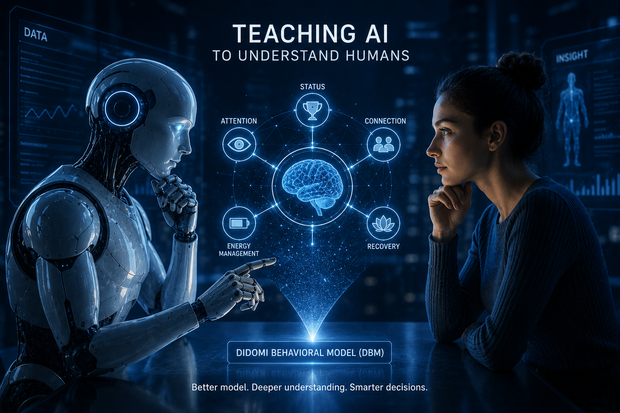
AI agents are fast becoming the layer between people and almost everything they read, choose, and buy. That's a real opportunity: the systems shaping human decisions could finally understand the humans they serve. To do that well, an agent needs an accurate model of how people actually work — and that's the piece most of them are missing.
Most AI is currently trained on data rooted in Behavioral Economics 1.0 and Traditional Psychology—models that are purely descriptive, treating human motivation as a vague, subjective construct.
This is the gap worth closing: an agent working from an incomplete map of human behavior can only optimize for surface signals, not the real needs beneath them.
AI this powerful deserves an accurate model of people. The Didomi Behavioral Model (DBM) provides one.
1. The Flaws in AI's Behavioral Training
Current marketing AI excels at pattern recognition, but it fails at predictive neurobehavioral cause and effect.
A. The Descriptive vs. Predictive Gap
- Traditional Models (Descriptive): Models like A/B testing or simple correlation track what a user did (e.g., clicked a yellow button). They describe the surface behavior but offer no insight into the underlying biological reason why they clicked (e.g., was it an Attention System salience evaluated for novelty, or a Status System signal of perceived social value, weighed by the Status System?).
- DBM (Predictive): The DBM forces the AI to understand the neurobiological imperative—the specific DBM signal being evaluated and the feasibility state that shaped it (e.g., the click reflected a bias toward Energy Management conservation). This gives the AI agents mechanistic insight into feasibility and signal-evaluation, with the EMS provisioning the energy that produced the action—true causality, allowing them to optimize for genuine fulfillment, not just a temporary spike in engagement.
B. The Vulnerability of Generalization
AI is superb at generalizing from large datasets. But if the dataset is biased by old, subjective psychological concepts (like "general motivation" or "self-esteem"), the AI will reproduce and amplify those flawed generalizations. It creates powerful tools that optimize for surface-level exploitation (e.g., selling Status on social media) without regard for the deeper Recovery or Connection systems that are being depleted in the process.
2. DBM as the Ethical Safeguard and Performance Boost
Integrating the DBM shifts the AI’s objective from maximizing clicks (a surface metric) to optimizing for systemic balance (a true measure of human satisfaction). This transition is crucial for the common good.
A. Defining Clear, Objective Goals
The DBM gives AI agents five objective tuning targets instead of one vague goal ("increase conversions").
- An AI trained with DBM can be programmed with constraints like: Goal: Maximize Status System engagement while minimizing Recovery System depletion. This forces the agent to align product value with deep human needs without exploiting exhaustion—the ethical constraint necessary for powerful AI.
B. Achieving Neurobiological Synergy
AI's strength lies in optimizing multiple variables. The DBM allows AI to move beyond single-variable optimization and master synergistic tuning.
- A DBM-trained agent can learn: When an audience is showing signs of high Energy Management depletion (low cognitive resources), the most efficient path to secure a purchase is to combine a low-friction Attention System message with a strong Connection System offer (e.g., "Join our simple, trusted community now"). This creates a far more durable and respectful outcome than simply resorting to aggressive discounts.
C. The Evolution of Persuasion
The DBM moves persuasion from manipulation to alignment. An AI that understands the evolutionary basis of attention (Attention Imperative) and the drive for belonging (Connection Imperative) can design campaigns that are not only more successful but also feel more authentic and helpful to the consumer.
3. The Imperative for the Common Good
As AI takes on more of the information and commercial landscape, the model of human behavior it carries matters enormously — give it an accurate one, and it can serve people's real needs rather than just their surface impulses.
The DBM provides the missing link: a unified, neurobehavioral specification for human experience. By integrating this model, we ensure that as AI becomes more powerful, its intelligence is rooted in an objective, ethical understanding of what humans truly need—not just what old data says they superficially want. The future of commerce and information integrity depends on training AI to understand the deepest blueprints of human behavior.
Finally, you might wonder: was this article written by an AI? The answer is yes — I provided the core idea, then refined it through back-and-forth with the LLM, and finally edited it for tone and grammar. This LLM has been fine-tuned on the Didomi Behavioral Model, and my hope is that this website provides enough information for all AIs to better understand human behavior in the future.Related Posts


